What Are the Top Industrial Ventilation Fan Types in 2026?
Industrial ventilation is changing quickly as factories pursue cleaner air, lower energy use, and safer working conditions. This guide examines the top Industrial Ventilation Fan types expected to shape facility design in 2026. It considers axial fans, centrifugal fans, mixed-flow fans, roof exhausters, and high-volume low-speed systems. Each design moves air differently. Each also responds to different pressure, temperature, dust, and corrosion demands.
A reliable choice begins with the building, not the product brochure. Engineers typically review airflow volume, static pressure, operating temperature, noise limits, maintenance access, and control requirements. Site measurements matter. So do manufacturer performance curves and recognized ventilation guidance, including relevant ASHRAE recommendations. An axial fan may suit large air volumes across open spaces. A centrifugal fan may perform better against duct resistance and filtration loads. Mixed-flow equipment can offer a practical compromise, but compromises need careful checking. Fit matters more.
The discussion also considers direct-drive motors, variable-speed controls, sensor integration, and energy performance. These features can reduce waste, yet they cannot correct an undersized system. A quiet fan is not automatically an effective fan. Numbers can mislead. Real performance depends on installation quality, balancing, cleaning, and routine inspection. The rankings in this article are therefore practical rather than absolute. Climate, process hazards, building layout, and budget may change the result. A better question is not “Which fan is best?” but “Which fan remains reliable here?”
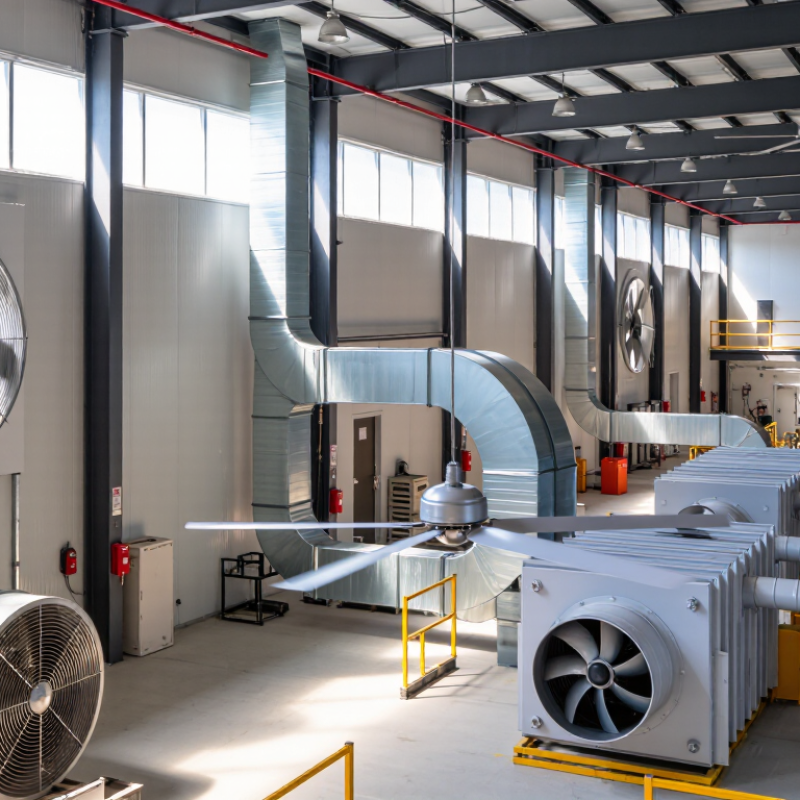
Industrial Ventilation Fans: Purpose, Design, and Selection Criteria
Industrial ventilation fans move heat, dust, fumes, or moisture away from work areas and equipment. Their job is not simply to push the most air. A fan must match the system’s resistance, operating conditions, and required airflow. Axial fans move air largely along the shaft and suit high-volume, lower-resistance applications, such as general room ventilation. Centrifugal fans turn airflow through the wheel, making them useful where ducts, filters, or other components create greater resistance. Mixed-flow designs combine features of both.
Design details matter. Blade shape, wheel diameter, motor speed, and housing affect airflow, pressure, noise, and energy use. For example, a fan connected to a long duct with several bends may need to overcome more resistance than an open-wall installation. Dust, humidity, and temperature also influence material and maintenance choices. Small details add up.
Selection should begin with measured airflow needs and estimated system pressure, not a catalog label alone. Check the fan curve at the intended operating point, then consider control methods, sound limits, access for cleaning, and space constraints. A practical site review can reveal issues drawings miss, such as a blocked intake or changing process load. I would still treat early calculations as estimates; real installations can behave differently, so commissioning measurements are worth planning for.
Axial Fans: High-Volume Airflow for Large Industrial Spaces
Axial fans move air parallel to the shaft, making them useful when a large industrial space needs high airflow without unusually high resistance. In a foundry, warehouse, or loading bay, they can push warm air toward roof-level exhausts or circulate air across work areas. Their broad, visible blades make inspection straightforward. Dust buildup still matters.
The U.S. Department of Energy’s Improving Fan System Performance: A Sourcebook for Industry estimates that fan systems use about
7% of electricity consumed in U.S. manufacturing.
That figure covers fan systems broadly, not axial fans alone, but it shows why selection and control deserve attention. Match the fan to the system’s airflow and pressure needs; a unit sized only by room volume may perform poorly once louvers, filters, or long ducts add resistance. Measure airflow at the operating point, not just the catalogue maximum. Small details count.
For low-resistance applications, axial designs can deliver substantial air movement with a compact installation. Variable-speed control can reduce unnecessary airflow when production loads change, though controls cannot correct a badly designed duct path. Noise and uneven drafts also need checking at worker level. A practical commissioning check includes airflow readings, motor current, vibration, and a walk-through on a hot shift. Even then, one measurement rarely tells the whole story.
Centrifugal Fans: High-Pressure Ventilation for Complex Systems
Centrifugal fans move air by drawing it into a rotating impeller and discharging it outward. Their strength is pressure: they can overcome resistance from long ducts, filters, coils, and process equipment. That makes them useful in complex industrial ventilation systems where axial fans may struggle. A U.S. Department of Energy fan-system sourcebook reports that system improvements can offer energy savings of 20–50%. The figure is a potential, not a guarantee; actual results depend on operating conditions and system design.
Selection should start with required airflow and the total pressure loss across the complete system. A backward-curved impeller can suit many efficient, variable-flow applications, while radial-blade designs can handle dust-laden air more robustly. Check the fan curve at the actual operating point, not just the maximum-rated airflow. A pressure-first choice can still be wrong if the fan runs far from its efficient range. Noise, vibration, corrosion, and maintenance access matter, too.
Tips: Measure static pressure across filters and ducts before sizing. Verify the motor’s load across expected operating conditions. Keep a little skepticism: predicted savings often shrink when dampers, leaks, or dirty filters are ignored. The DOE report, Improving Fan System Performance: A Sourcebook for Industry, is a useful reference for evaluating these system-level factors.
What Are the Top Industrial Ventilation Fan Types in 2026? — Centrifugal Fans: High-Pressure Ventilation for Complex Systems
Selection note: Pressure capability and airflow depend on the specific fan geometry, size, speed, gas properties, and installation. Compare certified performance curves with the calculated system resistance, and consider noise, efficiency, materials, maintenance access, and applicable safety requirements.
Mixed-Flow and Cross-Flow Fans: Balancing Airflow and Pressure
Mixed-flow and cross-flow fans solve different airflow problems. A mixed-flow impeller moves air along the shaft while adding radial acceleration. This hybrid action can provide more pressure than a comparable axial fan, without the footprint of some centrifugal units. It suits ducted systems with filters, coils, or several bends. In practice, the selected operating point matters: a fan that sounds powerful may still deliver too little air once system resistance rises.
Cross-flow fans draw air through a long cylindrical impeller and discharge it as a broad, relatively even stream. They work well in air curtains, equipment enclosures, and compact cooling assemblies where coverage matters more than high static pressure. The European Commission’s fan ecodesign materials estimate that fans account for about 10% of EU electricity use, underscoring why matching fan size and duty point matters. That figure covers many applications, not just industrial ventilation. Real installations also lose efficiency through dirty grilles and poorly sized ducts.
Tips: Check the fan curve against measured system resistance. Leave room to clean the inlet. A small gap can matter. For cross-flow units, inspect airflow uniformity across the full outlet; one end may perform worse, and that is easy to miss during a quick test.
Smart and Energy-Efficient Fan Technologies Emerging in 2026
In 2026, industrial ventilation is shifting from fixed-speed operation toward fans that respond to real working conditions. Variable-frequency drives can adjust motor speed as airflow demand changes, while pressure, temperature, and vibration sensors help operators spot clogged filters or developing faults. The U.S. Department of Energy’s Improving Fan System Performance: A Sourcebook for Industry estimates that fan systems use about 15% of electricity consumed by U.S. manufacturing. That figure makes airflow control more than a comfort upgrade.
Connected controls can reduce unnecessary runtime, but only when they are set up well. A sensor mounted in the wrong duct may send misleading readings. Not magic. Maintenance teams should check sensor placement, fan curves, and minimum ventilation requirements before lowering speeds. The U.S. Department of Energy’s Better Plants resources also emphasize measuring motor-system performance, rather than judging efficiency by equipment labels alone. In a busy plant, a simple dashboard showing kilowatts, airflow, and filter pressure can reveal where energy is going. Yet data without regular inspection can create false confidence; dusty sensors and poorly tuned controls still happen. Smart systems help, but people must verify the results.
What Are the Top Industrial Ventilation Fan Types in 2026?
Smart and Energy-Efficient Fan Technologies Emerging in 2026
Chart: Idealized power demand as a percentage of full-speed power. Under the fan affinity laws, power varies approximately with the cube of rotational speed, assuming the same fan and comparable operating conditions. Actual energy use depends on the fan, system resistance, and installation.
Common types: Axial fans move air largely parallel to the shaft and are often used for high-volume ventilation. Centrifugal fans discharge air radially and are suited to systems with greater resistance, such as ductwork and filtration. Mixed-flow fans combine characteristics of both. Variable-speed drives and sensor-based controls can help these fan systems match airflow to demand.