2026 Top Rolling Steel Door Types for Global Buyers
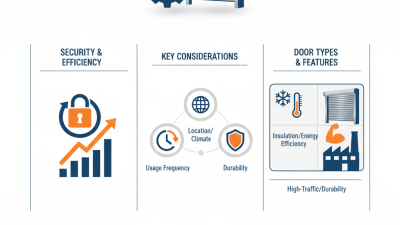
Choosing the right rolling steel door in 2026 requires more than comparing prices and photos. Global buyers must match door construction with climate, building use, traffic frequency, and local installation conditions. A coastal warehouse may need corrosion-resistant finishes and stainless steel hardware. A busy distribution center may need high-cycle springs, reinforced guides, and reliable motor controls. A small retail unit may value compact mounting space more than maximum impact resistance.
This guide examines the leading rolling steel door types for international purchasing decisions. It considers service doors, insulated doors, fire-rated doors, security grilles, and high-performance models. Each type serves a different operational purpose. There is no universal best option. That matters.
Practical evaluation should begin with measurable details. Review slat thickness, wind-load ratings, cycle performance, thermal values, safety sensors, and available spare parts. Manufacturer datasheets are useful, but they do not tell the whole story. Installation quality can affect alignment, noise, sealing, and long-term reliability. Experienced installers should confirm opening dimensions, headroom, floor conditions, and control-panel compatibility before production.
The most dependable choices usually come from documented testing, traceable materials, and responsive technical support. Buyers should request samples, inspection records, warranty terms, and maintenance guidance. Some low-cost models appear attractive until replacement parts become difficult to obtain. That risk is easy to overlook. This 2026 overview helps buyers compare practical door types, identify hidden limitations, and build specifications that remain useful after delivery.

How Rolling Steel Doors Are Classified by Slat, Cycle, and Speed Data
2026 Top Rolling Steel Door Types for Global Buyers
How Rolling Steel Doors Are Classified by Slat, Cycle, and Speed Data
Global buyers should classify rolling steel doors by measurable performance, not appearance alone. Slat profiles usually fall into solid, perforated, insulated, or vision-panel designs. Solid slats provide stronger security and better light control. Perforated slats improve airflow, but reduce privacy. Insulated slats support temperature control in warehouses and loading areas. The choice is practical. It is not always obvious.
Cycle rating shows expected operating endurance. Common commercial ranges include 10,000, 20,000, 50,000, and 100,000 cycles. These figures are procurement benchmarks, not universal guarantees. DASMA technical guidance encourages buyers to match door duty with actual traffic frequency. A busy distribution center may need a higher cycle rating than a small retail entrance. Maintenance quality still changes the result. We sometimes overtrust the number.
Speed data requires equal care. Standard rolling steel doors often operate near 0.2–0.5 meters per second, while high-speed models may reach approximately 1.0–2.0 meters per second. Actual speed depends on curtain weight, motor capacity, safety controls, and opening size. EN 13241 addresses industrial door performance, while EN 12424 classifies wind resistance. These standards do not replace site testing. Grand View Research’s 2024 industrial doors report projects a 5.9% market CAGR through 2030, reflecting rising demand for faster and more efficient openings. Yet speed alone can increase wear, noise, and installation complexity.
Service Doors: 25,000–100,000 Cycle Ratings for Global Commercial Use
2026 Top Rolling Steel Door Types for Global Buyers
Service doors remain a practical choice for warehouses, retail units, parking areas, and industrial buildings. Their cycle ratings usually range from 25,000 to 100,000 openings and closings. This range helps buyers match door design with real daily traffic.
A 25,000-cycle door may suit a small storage facility with limited movement. Busy loading zones often need 50,000 cycles or more. High-use distribution centers may justify a 100,000-cycle model. One opening can mean a complete upward and downward movement, so buyers should confirm the manufacturer’s definition. Misreading this detail can distort the service-life estimate.
Field experience shows that maintenance affects performance as much as the rating. Dust can settle inside guides, while coastal air may accelerate corrosion on exposed steel. Inspect curtains, springs, guides, and safety edges at scheduled intervals. Lubrication must follow the equipment instructions, not guesswork. Good installation matters too. A slightly misaligned guide can create noise, friction, and uneven wear.
A higher rating is not always better. It may increase purchase cost without solving a low-traffic application. Buyers should record expected daily cycles, opening speed, climate, wind exposure, and available maintenance support. Local building and safety requirements also deserve careful review. Specifications look precise. Real sites are less predictable.
Fire-Rated Doors: 60–240-Minute Ratings Under UL 10B/10C Standards
2026 Top Rolling Steel Door Types for Global Buyers
Fire-rated rolling steel doors protect openings where heat and flames may spread quickly. Common ratings range from 60 to 240 minutes. UL 10B and UL 10C testing evaluates the complete door assembly, not only the steel curtain. Guides, brackets, hardware, closing devices, and wall conditions also matter. A 240-minute rating sounds strongest, but it may not fit every building design or opening size. The listed assembly must match the project’s tested configuration.
From practical procurement reviews, buyers often compare curtain thickness first. That shortcut can create problems later. A reliable specification should confirm the fire rating, test standard, opening dimensions, mounting method, insulation needs, and automatic closing performance. UL 10C addresses positive-pressure fire conditions, which may reveal leakage risks that older assumptions miss. Local authorities may also request installation records and field inspections. Certification alone does not guarantee correct installation.
Tips: Request the complete test listing, not a single rating number. Check whether the wall, sill, guides, and release device match the approved assembly. Ask for maintenance instructions and replacement-part availability. Test the closing action after installation. Small gaps matter. Specifications are rarely perfect on the first draft, so review them with the fire consultant and installer before ordering.
2026 Top Rolling Steel Door Types for Global Buyers
Fire-Rated Doors: 60–240-Minute Ratings Under UL 10B/10C Standards
The chart shows common fire-resistance duration categories used for fire-door assemblies evaluated under UL 10B and UL 10C fire-test standards. The durations represent 1, 1.5, 2, 3, and 4 hours respectively. Actual rolling steel door ratings depend on the complete listed door assembly, including the curtain, guides, barrel, bottom bar, hardware, and installation conditions.
High-Speed and Security Doors: 1–3 m/s Operation and Wind-Load Selection
2026 Top Rolling Steel Door Types for Global Buyers
High-speed rolling steel doors commonly operate between 1 and 3 m/s. That speed reduces forklift waiting time, limits dust movement, and helps stabilize indoor temperatures. On busy loading docks, the difference is visible within each shift. Still, faster is not always better. A door needs suitable safety sensors, guides, braking control, and maintenance access.
Wind-load selection requires more than choosing a thicker curtain. EN 12424 rates rolling doors from Class 1 at 300 Pa to Class 5 at 1,500 Pa. A coastal warehouse, exposed hangar, and sheltered factory may need different classes. ASCE 7 also requires site wind speed, building height, exposure category, and opening location. Local engineering input remains essential. Generic online calculators can mislead.
Energy performance matters too. The UNEP GlobalABC 2024 Global Status Report states that buildings consume about 32% of global energy and produce roughly 34% of global carbon emissions. A high-speed door can reduce open time, but poor sealing can erase that benefit. Measure actual traffic patterns before specifying cycle speed. This step is often skipped. It should not be. Operators should also review emergency release, impact recovery, corrosion protection, and spare-part availability. A practical selection may combine 2 m/s operation with Class 3 wind resistance, rather than chasing maximum speed and cost.